early in the story, a hot spring sunset
Meeting at the Patriarch's Ponds
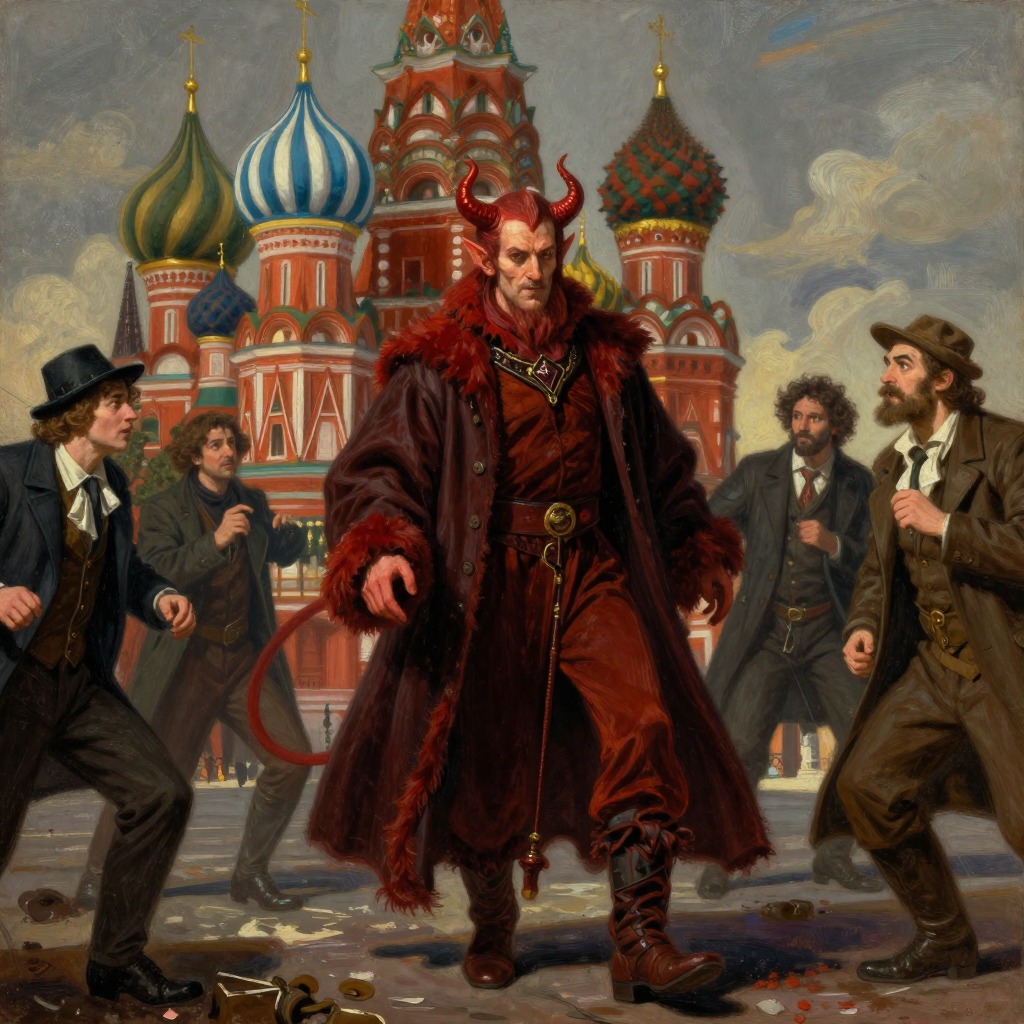
Mikhail Alexandrovich Berlioz and Ivan Homeless discuss Berlioz's commissioned anti-religious poem at the Patriarch's Ponds. Berlioz argues that Jesus never existed, citing ancient historians. A mysterious foreigner, later identified as Woland, joins them and contradicts their atheism, claiming Jesus did exist. Woland predicts Berlioz's death by decapitation at the hands of a Russian woman, Annushka, and mentions that Annushka has already spilled sunflower oil, which will cause the meeting not to take place. This encounter sets the stage for the novel's supernatural and philosophical conflicts.
immediately after the meeting at the Patriarch's Ponds
Woland's Story of Pontius Pilate
Woland begins narrating the story of Pontius Pilate, the procurator of Judea, on the morning of the fourteenth of Nisan. Pilate suffers from a severe headache and is forced to interrogate Yeshua Ha-Nozri, a wandering philosopher accused of inciting the destruction of the temple. Yeshua impresses Pilate with his ability to heal his headache and his radical philosophy that all people are good and that all authority is violence. Pilate is torn between his personal sympathy for Yeshua and his political duty to uphold Roman law.
later the same morning, during the trial
Pilate's Confirmation of the Death Sentence
Despite his desire to save Yeshua, Pilate is forced to confirm the death sentence after learning that Yeshua spoke against the authority of Caesar. Pilate attempts to persuade the high priest Joseph Kaifa to release Yeshua instead of the rebel Bar-Rabban, but Kaifa refuses. Pilate's cowardice in the face of political pressure leads to Yeshua's condemnation. The scene highlights the theme of cowardice as the most terrible vice.
immediately after the conversation at the Patriarch's Ponds
Berlioz's Death Under the Tram-Car
Berlioz, attempting to leave the Patriarch's Ponds, slips on the spilled sunflower oil and falls under a tram-car, which decapitates him. This fulfills Woland's earlier prediction. Ivan Homeless witnesses the accident and realizes that the mysterious foreigner knew about it in advance. The event triggers Ivan's frantic chase after Woland and his retinue.
immediately after Berlioz's death, evening
Ivan's Chase and Arrest
Ivan Homeless, convinced that Woland is a murderer and spy, chases him through Moscow. He encounters Woland's retinue, including Koroviev and a giant black cat named Behemoth, who ride a tram-car. Ivan loses them but eventually bursts into a stranger's apartment, steals a candle and an icon, and swims in the Moscow River. His clothes are stolen, and he ends up at Griboedov's restaurant in his underwear, causing a scandal. He is subdued and taken to a psychiatric clinic.
the same evening, around midnight
The Scandal at Griboedov's
At Griboedov's, the restaurant of the literary association Massolit, writers are waiting for Berlioz to chair a meeting. News of his death arrives, causing grief and confusion. Ivan Homeless bursts in, half-dressed and carrying a candle, accusing Woland of murder. He attacks a writer and is eventually tied up and taken away by the police. The scene satirizes the literary establishment's hypocrisy and self-indulgence.
later that night, at the clinic
Ivan's Diagnosis and Hospitalization
Ivan is brought to Professor Stravinsky's psychiatric clinic, where he is diagnosed with schizophrenia. He is given a sedative and placed in a private room. Despite his protests, he is treated as a mental patient. The doctor, Stravinsky, calmly explains that Ivan's story about Woland and Pontius Pilate is a symptom of his illness. Ivan begins to doubt his own sanity.
the next morning, around 11 am
Woland's Visit to Styopa Likhodeev
Stepan Likhodeev, director of the Variety Theatre, wakes up with a severe hangover in his apartment, which he shares with the late Berlioz. He finds Woland in his bedroom, along with his retinue: Koroviev, Behemoth, and Azazello. Woland reveals that Likhodeev signed a contract for a black magic performance. The retinue accuses Likhodeev of incompetence and corruption, and Azazello magically transports him to Yalta. The scene establishes Woland's power and his takeover of the apartment.
the same morning, after Likhodeev's disappearance
Koroviev's Stunts with Nikanor Ivanovich
Nikanor Ivanovich Bosoy, chairman of the tenants' association, visits Apartment No. 50 to investigate. Koroviev, pretending to be an interpreter, bribes him with dollars to rent the apartment to Woland. Nikanor accepts the bribe and hides the money. Later, Koroviev anonymously reports him to the police for currency speculation. Nikanor is arrested and eventually sent to the psychiatric clinic, where he has a bizarre dream about a theatre where currency dealers are forced to confess.
the same morning, at the Variety Theatre
The Telegrams from Yalta
Grigory Danilovich Rimsky, the financial director of the Variety Theatre, and administrator Ivan Savelyevich Varenukha receive a series of telegrams from Yalta, allegedly from Likhodeev, claiming he was magically transported there. Despite the impossibility, the handwriting matches Likhodeev's. Rimsky sends money to Yalta, but Varenukha is warned by a mysterious phone call not to deliver the telegrams. The scene creates confusion and foreshadows the supernatural events.
the same afternoon, during a storm
Attack on Varenukha
Varenukha, attempting to deliver the telegrams, is attacked in the theatre's toilet by Azazello and a cat-like man. They beat him and drag him to Apartment No. 50. There, a naked red-haired vampire girl, Hella, kisses him, turning him into a vampire. Varenukha later returns to the theatre as a vampire, lying to Rimsky and casting no shadow. The scene introduces the theme of vampirism and the supernatural corruption of the theatre staff.
the same night, at the clinic
Ivan's Conversation with the Master
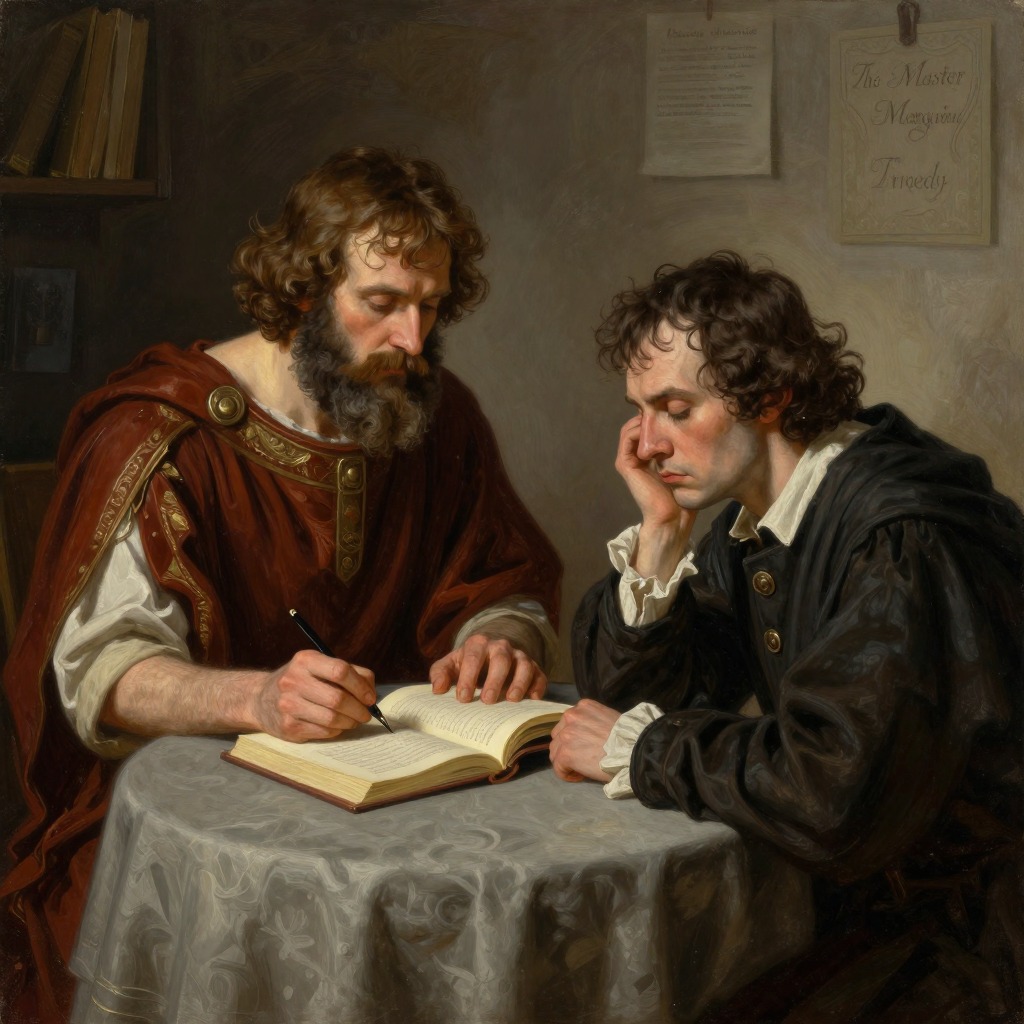
Ivan Homeless meets a mysterious visitor in the clinic, who introduces himself as the master. The master tells Ivan his story: he was a historian who won a lottery, quit his job, and wrote a novel about Pontius Pilate. He fell in love with a woman, Margarita, who became his secret wife. The novel was rejected by publishers, and critics attacked it. In despair, the master burned the manuscript and ended up in the clinic. He reveals that Woland is Satan.
the same evening, during the performance
The Black Magic Seance at the Variety Theatre
Woland, accompanied by Koroviev and Behemoth, performs a black magic seance at the Variety Theatre. They entertain the audience with tricks, including a rain of counterfeit money that turns out to be real. They open a ladies' shop, where women exchange their old clothes for new ones. The master of ceremonies, Georges Bengalsky, is beheaded by Behemoth but later restored. The seance exposes the greed and vanity of the audience, and ends in chaos.
later that night, after the seance
Rimsky's Flight from Moscow
After the seance, Rimsky is alone in his office. The vampire Varenukha returns and tries to attack him, while Hella attempts to enter through the window. Rimsky is saved by the crowing of a rooster, which forces the vampires to flee. Terrified, Rimsky escapes to the Leningrad express train, leaving Moscow. His hair turns white from fear. The scene marks the complete breakdown of the theatre's administration.
the same night, at the clinic
Nikanor Ivanovich's Dream of the Currency Theatre
Nikanor Ivanovich, now a patient at Stravinsky's clinic, has a vivid dream. He is in a theatre where a master of ceremonies forces currency dealers to confess and turn over their hidden money. The dream includes a performance of Pushkin's 'The Covetous Knight' and a scene where a man named Kanavkin confesses. Nikanor himself is pressured but insists he has no currency. The dream satirizes the Soviet obsession with currency and the terror of the secret police.
the afternoon of the fourteenth of Nisan
The Execution of Yeshua Ha-Nozri
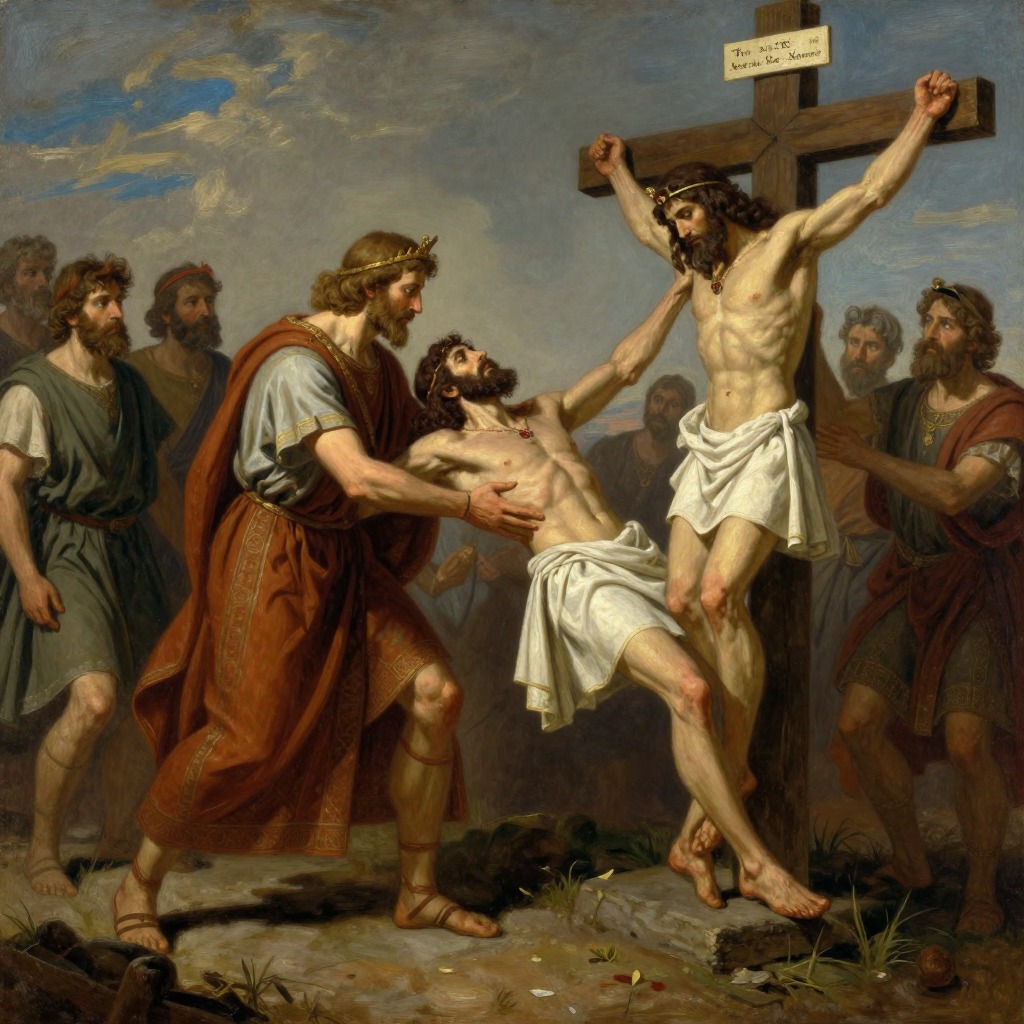
Yeshua Ha-Nozri is crucified on Bald Mountain alongside two other criminals, Dysmas and Gestas. Matthew Levi, his disciple, watches from a distance, anguished and cursing God for not saving Yeshua. As a storm approaches, the executioners give Yeshua a sponge soaked in water, then kill him with a spear. Levi later cuts down Yeshua's body and takes it away. The scene is a stark depiction of suffering and the failure of faith.
the next morning, Friday
The Unquiet Day at the Variety Theatre
The Variety Theatre is in chaos. The staff cannot find Likhodeev, Rimsky, or Varenukha. The police investigate, but the contract with Woland is missing, and no one remembers his name. The bookkeeper Vassily Stepanovich Lastochkin tries to report the events to the Commission on Spectacles, but finds the chairman, Prokhor Petrovich, transformed into an empty suit. He then goes to the financial sector, where the money he tries to deposit has turned into foreign currency, leading to his arrest.
the same morning, at the Commission and its affiliate
The Suit Incident and the Singing Affiliate
At the Commission on Spectacles, Prokhor Petrovich has been transformed into an empty suit that continues to work. His secretary, Anna Richardovna, is hysterical. Meanwhile, at the affiliate, a choirmaster (Koroviev in disguise) starts a singing club, and the entire staff is compelled to sing uncontrollably. They are taken to Stravinsky's clinic. The scenes satirize Soviet bureaucracy and the absurdity of forced collectivism.
the same morning, at the train station
Berlioz's Uncle Arrives in Moscow
Maximilian Andreevich Poplavsky, Berlioz's uncle from Kiev, arrives in Moscow after receiving a mysterious telegram about Berlioz's death. He hopes to inherit Berlioz's apartment. He goes to Apartment No. 50, where he is met by Koroviev and Behemoth, who mock him and tell him the apartment is not for him. Poplavsky is frightened and leaves. The scene highlights the greed and opportunism of relatives.